Author: ckcfadmin
Donnor Connection – April 2023
Hello from Central Kansas Community Foundation!
We hope tax season has treated you well! We know it’s a busy time for our fund holders, and we’ve appreciated hearing from you in these early months of the year. We’re also encouraged by how many of you who are not yet fund holders have reached out about getting started with the community foundation. There are so many ways we can work together, ranging from helping you set up a donor-advised fund at the community foundation so that you can better organize your giving, to helping you and your family dig deeper into the community issues that interest you.
In this issue, we are taking a step back to explain RMDs and QCDs. We field so many great questions from fund holders about how these two concepts work together in the context of IRAs and charitable giving, so we are offering up a longer article to walk through the points one at a time.
You will also see that we are building on the theme of tax time as a great point in the year to solidify your charitable giving plans, and we are touching on three hot topics to keep you up to date on what’s going on in the charitable giving world.
Thank you for the opportunity to work together! We are grateful!
–CKCF
Boiling down the alphabet soup: What actually are RMDs and how do they relate to QCDs?
 If you get cross-eyed when you start reading about Required Minimum Distributions (RMDs) and Qualified Charitable Distributions (QCDs), you are not alone! And, given the December 2022 passage of SECURE 2.0 legislation, changes to RMD rules are especially important to understand if you are involved in charitable giving and have reached the age of 70 1/2.
What is an RMD in the first place?
A little history may help here. RMDs date back to 1974 when the Employee Retirement Income Security Act (ERISA) was enacted to provide for pension reform and to offer a retirement savings vehicle to non-pensioned workers through vehicles referred to as “qualified retirement plans” that are allowed to grow tax-free while assets are in the plan.
By requiring that a taxpayer start taking distributions from qualified retirement plans when the taxpayer reaches a certain age, the United States government is able to start collecting tax revenue on these “required minimum distributions” from assets that have grown tax-deferred for all those years and decades.
Now here is where we get into the weeds. The distributed amount of the RMD is reported by the plan administrator on IRS Form 1099-R (but–and here’s a nuance–not if the RMD was “satisfied” by a Qualified Charitable Contribution [QCD]—see below!). A taxpayer enters this amount on Line 4B of the Form 1040 Federal income tax return, and, of course, the amount is included as taxable income for the year it was distributed. So, the net-net here is that RMDs add to taxable income but not in the case of direct transfers to qualifying charitable organizations (the QCD).
What types of accounts require RMDs?
For 2023, account owners aged 73 and older who participate in qualified retirement plans such as these are subject to RMDs:
Traditional IRA
Simplified Employee Pension (SEP)
SIMPLE IRA
Employer-sponsored 401(k), 430(b) or 457
Once begun, RMDs occur annually, until account depletion or the owner’s death. (Note that distributions must also be taken from inherited IRA accounts, though under different rules.)
How is the RMD amount calculated?
A qualified retirement account’s entire balance is considered for calculating an RMD calculation, although of course only a fraction of the balance must be distributed each year. Unfortunately, the distribution amount is not easily or consistently determined. This contributes to some retirees’ confusion about RMDs and the requirements. Online RMD calculators can be found here or here, and your retirement account administrator can provide guidance.
When do the RMDs start?
That’s tricky, too! For years 2023 – 2032, the start date is your age-73 calendar year. For example, a 1955-born account owner would begin in 2028. Beginning in 2033, it’s your age-75 calendar year. Account holders born in 1960 enjoy a sort-of “two-year extension,” given that they would turn 73 in 2033. But since the age-75 provision begins January 1, 2033, their RMD begins in 2035.
For all account owners, the big benefit of the now-later RMDs comes from retaining account balances longer. You avoid adding unnecessarily to your taxable income and therefore reduce the risk of bumping to a higher tax bracket. Prior to SECURE Act increases passed in 2019 and 2022, RMDs began at age 70 ½ and age 72. So taxpayers can now enjoy a few more years of tax-free investment growth.
How charitable taxpayers can check the RMD box with a QCD
Here’s where the QCD comes in (finally!) Now, armed with an understanding of how the RMD rules apply to your situation, you can begin to see how the QCD can provide a huge benefit if you own IRAs. QCDs are truly taxpayer and charity-friendly vehicles.
For starters, you can start making QCDs at age 70 ½–well before you’ve reached the age when you’re required to take RMDs. A QCD happens when you direct a distribution from an IRA of up to $100,000 annually (or $200,000 if you file tax returns jointly) to one or more qualifying charitable organizations, including a designated, field-of-interest, or unrestricted fund at the community foundation. While the QCD is itself not tax deductible per se, the overall effect of the QCD is to lower your taxes because the QCD counts toward your RMD but, unlike an RMD, it is not included in your taxable income.
The bottom line? If you have reached the age of 70 ½, own an IRA, care about charitable causes, and don’t need a full RMD income to cover your living expenses, reach out to the community foundation to learn how a QCD could work beautifully for you.
‘Tis the season: Why tax time is often the best time to get serious about your charitable plans
 Though often unappreciated, the annual passage of tax season has benefits.
For one, it offers some finality to the prior year in that we finally know if we owe or are due a refund. For example, for the 2021 tax year, the IRS processed 88 million refunds averaging $3,039 each. Simultaneously, filing a 2022 tax return often comes with finalizing quarterly tax estimates for 2023, which many people use to build a framework for current-year spending.
Fortunately, charitable giving ranks high on many “how to use your refund” lists. Whether you have “bonus” money in the form of a refund or gain some peace of mind by knowing your upcoming tax obligations, giving intentionally and strategically always helps that gift go further.
Unfortunately, though, strategic and intentional giving may get lost when gifts to charity are made through a quickly mailed check or an online payment in response to a phone solicitation, television ad, mailer or online advertisement. The community foundation, however, offers remedies for this!
Lean into intentionality
Many donors give to the same causes annually, with causes tied to faith, health and community ranking high among charitable giving trends. Recently, gifts involving food or home insecurity, natural disasters and international conflicts have become increasingly popular.
Most important is to give to causes that are near and dear to you and for which you can see the ways your giving is contributing to meaningful, positive change in the lives of people in our community. And if you can add to your current list of beneficiary organizations to achieve meaningful impact, all the better.
The community foundation is a knowledgeable source of ideas, best practices, and data-driven approaches to helping you measure your impact. Our team can be especially helpful if you have a cause in mind but may not immediately have an organization name or local chapter to support. Our team has vetted and even pre-qualified many worthy organizations, and as a bonus, offers security against sending gifts to scammers or bad actors who often start or perpetuate their deceit by using familiar-sounding names of well-known organizations or websites.
Level up your strategy
Now that you’ve identified budget targets for your charitable giving and have a strong sense of the causes you’d like to support, structuring your gift for maximum impact and tax savings should be a top priority.
If you already have a donor-advised fund at the community foundation, you know that this vehicle has many benefits, including ready access to our staff of experts; the convenience of jumping online to supporting favorite causes from your fund; the ability to maximize a gift with accompanying tax benefits; and even the opportunity to schedule a gift to coincide with the occasional matching campaign hosted by a favorite charity. With full tax deductibility in the year of the contribution, donor-advised funds are an ideal way to “mentally offset” current year tax estimates that become known in April. If you don’t yet have a donor-advised fund at the community foundation but are considering it, this may be the perfect time to jump in.
With these tips in hand, and with the help of the community foundation, you can better plan for the tax year ahead, knowing that causes important to you, whether legacy or new, will benefit from your generosity.
Popular topics: Banking fall out, proposed legislation, and new stats on volunteerism
 Not a day goes by at the community foundation without our team talking with fund holders–and potential fund holders!–about philanthropy in our community and all the ways charitable giving can make life better for everyone who lives here. Recently, we’ve noticed an uptick in interest on a few important topics.
Ripple effects of banking’s bumpy road
Understandably, our team has fielded a lot of questions from fund holders working with their advisors about transferring bank and especially tech stocks to their donor-advised or other funds at the community foundation. Although the current market climate may be rough, we are nevertheless encouraged by evidence suggesting that technology is increasing the opportunity and efficiency of charitable giving overall, and certainly we are hearing about (and talking with) more and more donors who are deploying their business and financial success toward charitable initiatives. Silver linings do indeed appear to be a real thing!
Tax perks on the horizon?
It appears that there may be renewed hope for non-itemizers to be able to deduct at least a portion of their charitable gifts. As you and other charitable-minded taxpayers are undoubtedly aware, because of the higher standard deduction passed as part of the Tax Cuts and Jobs Act of 2017, tens of millions fewer households itemized their deductions, leaving many nonprofits with shortfalls in projected donations. In addition, a “universal charitable deduction” may be back in play.
Generational factors can impact charitable behavior
Many fund holders at the community foundation regularly involve their children and grandchildren in philanthropic activities, including attending community foundation events together and meeting with our team to explore giving opportunities and assessing impact. It may interest you (but it may not surprise you) to learn that studies continue to point out generational differences in approaches to charitable giving. Recently, for example, research has shown that volunteerism and related behaviors are shifting, making it difficult for some charities to build and maintain volunteer programs.
We look forward to working with you and your family this spring to set in motion your charitable goals for 2023! Please reach out anytime.
2023 CKCF Affiliate Summit: Lead. Match. Grow
 On March 2, 2023 Central Kansas Community Foundation (CKCF) hosted the annual CKCF – Affiliate Summit entitled Lead. Match. Grow. Our Guest Speaker was Ed O’Malley, President and CEO of Kansas Health Foundation (KHF) and formerly with Kansas Leadership Center, created an environment of inspiration for the nearly 50 attendees at the Sand Creek Event Center in Newton, Kansas. His message encompassed the vision Kansas Leadership Center exemplifies with a basic tenet that everyone has a leadership position, and the best results and achievements are experienced when it is exercised by all. He shared highlights from his latest book, When Everyone Leads: How The Toughest Challenges Are Seen And Solved, to guide his genuine message calling our group of board members and staff to be active in our work serving communities. Several books were given away during the days events and activities.
As we transitioned from LEADing to MATCHing, O’Malley acknowledged the history of KHF providing matching grant funds for the establishment and growth of Community Foundations in Kansas for more than 20 years. He celebrated with us as we announced our new partnership with Patterson Family Foundation. They are investing in eligible community foundations, across Kansas and part of Missouri, a 70,000-match program for growing rural communities. This is a tremendous opportunity for the central Kansas service area. O’Malley encouraged engaging in our foundations in new ways and taking bold steps to achieve this match and beyond that work to understand what ones community is really seeking to achieve, identifying what is the not only the mission but what is the vision. How will you know you are successful.
In preparation for launching MATCH initiatives, Megan Smith was brought on to the CKCF team as a Development Consultant. Megan has over 15 years of experience in fundraising. During the Summit she walked through guidelines for the Patterson Family Foundation match program and offered her services for support of affiliate planning. With the excitement of this opportunity, we recognized Marketing and Communication preparation will be key. Laurel Woodward-Breckbill, a freelance Marketing Consultant for CKCF was invited to provide tips on storytelling, marketing tools and use of social media for broadening awareness as a foundation as well for a specific event. Table top discussions were sprinkled in throughout the day and provided participants a chance to share ideas and best practices from raising awareness to event ideas. Laurel as well as Andrea Braker at Community Creative Services are resources to affiliates to help supporting their marketing and communication efforts.
Thanks to staff at CKCF and the Development and Appreciation Committee for making the venue comfortable and inviting. We also thank Lyndsey Cakes and Bakes for providing the lunch.
Men’s Giving Circle expands membership and impact
Menocause, a component fund of Valley Center Community Foundation, has grown and sustained
membership of 101 men in 2021 and 2022. In February they awarded $25,250 in grants to local
charities and invested $25,500 in their endowment.
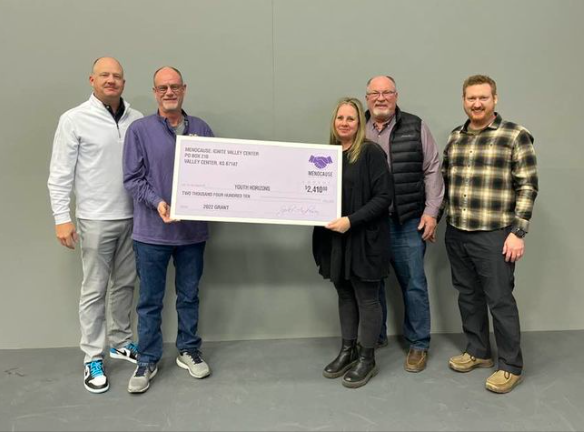
One of the grant recipients, the Youth Horizons Wren House, serves at-risk girls in Sedgwick County. According to Spike Anderson, Menocause founder and board member, the Menocause Grant Review Committee felt compelled to support the Wren House, a first-of-its-kind project which opened in Valley Center in 2022. He hopes Menocause grant will help give the program a solid start.
Continue Reading to learn more about the Wren House.
Wren House provides mentoring and other services in a nurturing and safe environment. The
home will offer programs designed to help its residents function at higher levels, avoid missteps and setbacks through earlier intervention, and enjoy a continuum of care that helps them eventually transition into independent living. The first phase will create capacity for 12 girls.
Where will these girls come from?
Girls and young women trapped in tough circumstances endure among us. They roam in daylight and in the shadows, often lacking access to resources, trusted networks, and other support necessary to build a better life. They are preyed on by perpetrators, ensnared in a cruel cycle of abuse, and rank among our community’s most vulnerable. To address this community need, YH is building the Wren Home on 40 acres donated by late philanthropist Keith Wren. Mr. Wren requested his gifted land be developed in a way that provides for girls and young women who are at-risk of human trafficking.
How it will be used to serve
The Wren Home will serve as a key partner in a collaborative local effort to combat teenage runaways, early alcohol and substance addiction, prostitution, and other forms of physical and mental health abuse. The Wren Home process has included research, engaged many stakeholders and featured a diverse task force that continues to provide counsel. Project partners include Hope Ranch, St. Francis Child Services, and the Wichita State University Center for Combating Human Trafficking. The collaboration will produce a Wren Home Advisory Board, comprised of leaders and other advocates who will help ensure success.
Donor Connection – March 2023
Hello from the community foundation!
Thank you for the opportunity to work with you!
In this newsletter, we’re addressing three common myths about private foundations and donor-advised funds. It may surprise you to learn more about the differences between these two vehicles and how they can work together as part of your overall philanthropy strategy developed with the help of the community foundation team. We’re also covering ways you can focus your philanthropy, as well as offering a couple of resources for going deeper into philanthropy trends such as disaster giving.
If you are already a fund holder at the community foundation, thank you! If you are considering setting up a fund, we appreciate your consideration! It is our pleasure to serve charitable individuals, families, and businesses through donor-advised funds, field-of-interest funds, scholarship funds, and unrestricted funds. We are here to help you achieve the charitable goals that are important to you. Please reach out anytime!
All the best for the month of March!
Private foundations and donor-advised funds: Debunking three myths
 If you’ve been involved with charitable giving for a few years, you’ve no doubt become familiar with both private foundations and donor-advised funds and their popularity as charitable giving tools. As is often the case with tax and estate planning-related topics, the differences between private foundations and donor-advised funds are sometimes the subject of confusion and misunderstanding.
As you work with your advisors and the team at the community foundation to establish your immediate and long-term charitable giving plans, take a few minutes to check out how to debunk these three common myths.
Myth #1: Donor-advised funds are all the same and only private foundations can be customized
Private foundations will always differ from donor-advised funds in important ways not only because of their status as separate legal entities and the deductibility rules for gifts to these entities, but also because of the opportunities to customize governance. But it is a mistake to think that a donor-advised fund is a cookie cutter vehicle. Indeed, “donor-advised fund” is simply a term used to specify the structure of a fund and its relationship with a sponsoring organization such as a community foundation. The donor-advised fund vehicle itself is extremely flexible.
–Donor-advised funds are popular because they allow a donor to make a tax-deductible transfer of cash or marketable securities that is immediately eligible for a charitable deduction. The donor can recommend gifts to favorite charities from the fund when the time is right.
–A donor-advised fund at the community foundation is frequently a more effective choice than a donor-advised fund offered through a brokerage firm (such as Fidelity or Schwab). That’s because, at a community foundation, you and your family are part of a community of giving and have opportunities to collaborate with other donors who share similar interests.
–The community foundation can work with you and your family on a charitable giving plan that extends for multiple future generations. That is because the team at the community foundation supports your family in strategic grant making, family philanthropy, and opportunities to gain deep knowledge about local issues and nonprofits making a difference.
As you explore the many opportunities to deepen your work with the community foundation, consider the unique mix of flexibility and services available to you and your family when you establish a donor-advised fund.
Myth #2: Deciding whether to establish a donor-advised fund or a private foundation mostly depends on size
The size of a donor-advised fund, like the size of a private foundation, is unlimited. The United States’ largest private foundations are valued well into the billions of dollars. (Information about private foundations, ironically, is not so private. The Internal Revenue Service provides public access to private foundations’ Form 990 tax returns. That is not the case for individual donor-advised funds.)
Similarly, donor-advised funds are not subject to an upper limit. Although information on the asset size of individual donor-advised funds is not publicly available, anecdotal information indicates that some donor-advised funds’ assets may total in the billions of dollars.
Indeed, a donor-advised fund of any size can be an effective alternative to a private foundation, thanks to fewer expenses to establish and maintain, maximum tax benefits (higher deductibility limitations and fair market valuation for contributing hard-to-value assets), no excise taxes, and confidentiality (including the ability to grant anonymously to charities).
The net-net here is that the decision whether to establish a donor-advised fund or a private foundation–or both–is much less of a function of size than it is other factors that are more closely tied to the objectives a donor is trying to achieve.
Myth #3: Donor-advised funds and private foundations are mutually exclusive
Many philanthropists and their advisors are aware of the many benefits of using both a donor-advised fund and a private foundation to accomplish their charitable goals. For example:
–Donor-advised funds can help meet the need for anonymity in certain grants, which is typically difficult using a private foundation on its own.
–A donor-advised fund can receive a family’s gifts of highly-appreciated, nonmarketable assets such as closely-held stock and real estate, and benefit from favorable tax deduction rules not available for gifts to a private foundation.
–An integrated donor-advised fund and private foundation approach can help a family balance and diversify its investment and distribution strategies to ensure that giving to important causes remains steady even in market downturns.
Some private foundations are even considering transferring their assets to a donor-advised fund at the community foundation to carry on the foundation’s mission. Terminating a private foundation and consolidating giving through a donor-advised fund is sometimes the best alternative for a family when the day-to-day management and administration of the private foundation has become more time-consuming than expected and is taking time and focus away from nonprofits, the community, and making grants. In addition, some families find that the tax rules related to investments, distributions, and “self-dealing” have become harder to navigate and are perhaps even preventing the family from maximizing tax benefits of charitable giving. Finally, the administrative load of managing a private foundation sometimes becomes overwhelming, especially if the family members who handled these functions initially have retired, passed away, or simply become busy with other projects.
Evaluating options for focusing your philanthropy
 If you’ve been giving to favorite charities for many years, it will not surprise you to learn that most donors are interested in deepening and focusing their impact as they maintain the frequent and total amount of giving.
Focusing on impact is hard, but it’s easier when you work with the community foundation and follow best practices for making grants to favorite causes. The community foundation’s expertise can be invaluable to you and your family as you pursue your charitable goals.
Here are three suggestions for refining your giving strategies to support your favorite causes.
Educate yourself.
Learn about best practices that are emerging in the growing field of philanthropy. You can discover various philosophies that can drive charitable giving and gain insights from examples of what other philanthropists report has worked well and not so well. Working with the community foundation team is an excellent way to gain access to the most up-to-date research and resources on making an impact, including ways to make decisions with your partner or involve your family.
Follow your heart.
Your charitable giving is going to be most effective when you support the causes you truly care about. You’ll be more committed and better able to focus on impact if you experience the psychological rewards of providing financial support to organizations that align with your personal beliefs about how quality of life can improve for people in the community.
Seek information.
Information about nonprofit organizations is widely available to you through several online sources, including being able to access nonprofit organizations’ tax returns to see detailed financial data. As you do your online research, consult the team at the community foundation. We are happy to interpret the information available online and provide important context for the meaning of that information as it relates to the actual work of the nonprofit organization and the ways you are supporting it.
Go deeper
 Many donors are continuing to support relief efforts in Ukraine, as well as exploring how to help the victims of the earthquakes in Turkey and Syria. The team at the community foundation is happy to help you balance your desire to meet the most critical needs in our local community while also supporting international relief efforts. Please reach out anytime. Our team is also happy to share insights about what’s trending in philanthropy overall, including best practices in disaster giving. We are here to help you achieve your short-term and long-term charitable goals and work with you and your advisors to do so in the most tax-effective manner.
CKCF INTRODUCES…
NEW HIRE: CKCF PROGRAM ASSISTANT, PATTY MELLINGER
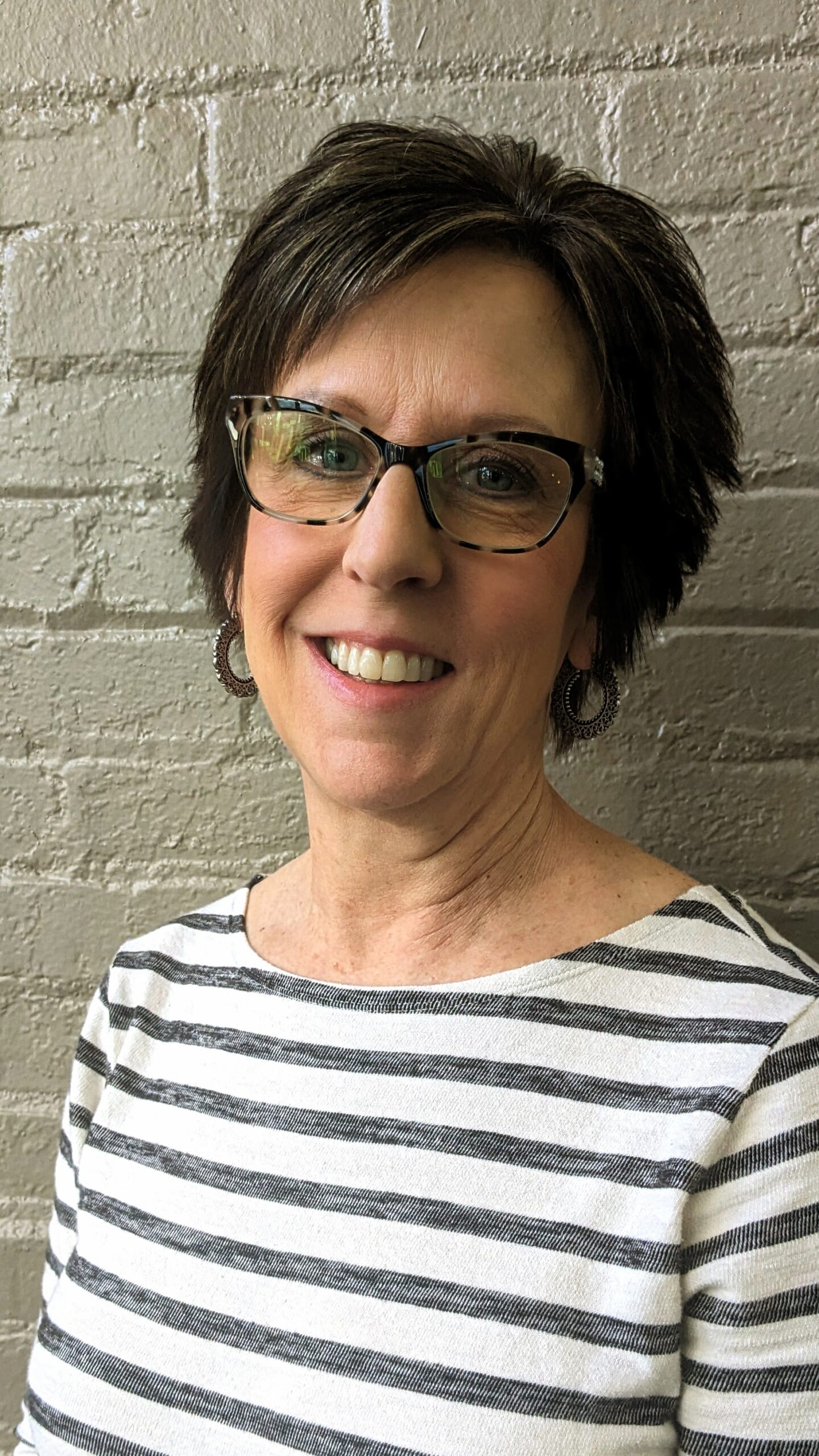 Hello! My name is Patty Mellinger. I grew up in the Hutchinson area and graduated from Buhler High School. I received my bachelor’s degree in Social Work from Bethel College. Most of my working years were with Harvey County Parents as Teachers. I worked for 15 years as a parent educator, serving families in Newton, Hesston, and Halstead.
I have been married to John for 31 years and we have two grown daughters, Lauren Miller (Dalton) and Courtney Stucky (Kyle). We are blessed to have our family living close, Lauren in Topeka and Courtney in Newton. We also have a funny dog that is a Schnauzer/Havanese mix, named Winston.
I am excited to be the Program Assistant with the Central Kansas Community Foundation! I have been working in the “for profit” sector in Wichita for the past few years, and I look forward to being back in Newton in the non-profit world again, serving the Newton community and Central Kansas.
NEW CONTRACT PARTNER: MEGAN SMITH, G2 SOLUTIONS
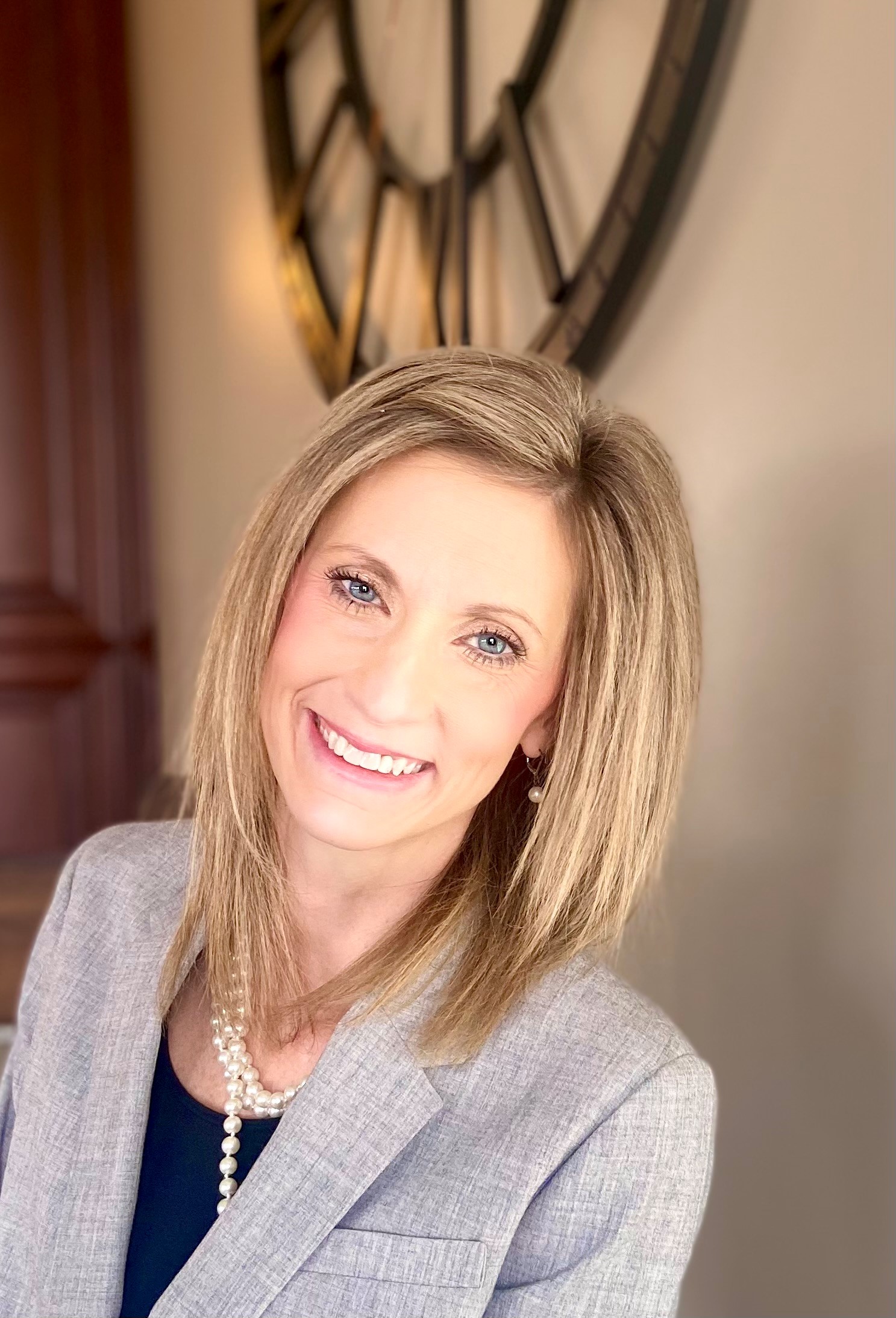 Megan Smith is founder and owner of G2 Solutions, LLC specializing in non-profit consulting along with custom marketing and communication solutions for non-profits and small businesses.
She has 15 years of non-profit and small business experience and brings a broad background and skillset to the table when collaborating with partners. The focus of her contract with CKCF in 2023 will be cultivating donor relationships, coordinating the new CKCF Spring Soiree and rolling out a new opportunity for affiliate foundations.
Megan enjoys the opportunity to work creatively and build relationships with local organizations. She is a graduate of Hesston High School and Baker University; Megan and her family live in Hesston.
Donor Connection – February 2023
Hello from the community foundation!
We are excited that 2023 is in full swing. Our team appreciates the many opportunities already this year to talk with those of you who are current fundholders, as well as those of you who are considering becoming fundholders. We look forward to working with current and new donors through donor-advised funds, field-of-interest funds, scholarship funds, or unrestricted funds at the community foundation to achieve the charitable goals that are important to you and your family.
Our update this month covers the importance of local giving, trends in corporate giving, and tips to keep top of mind as you, your family, and your advisors work together to pursue your philanthropic priorities.
Happy February! Thank you for the opportunity to work together.
Angie Tatro, CEO
Community foundations: Unparalleled resources for local giving with major impact
 As economic times get tough, more and more people are asking how they can make the biggest difference right in their own backyard. Indeed, local giving is a topic that has even made its way into the opinions of the mainstream media, causing many charitably-inclined people to pay more attention to the impact their dollars are having on the causes they love.
Sometimes the greatest needs really are right here at home. As donors explore charitable giving opportunities and receive requests for funding from charities near and far, it can be helpful to read first-hand accounts of why other philanthropists have been so inspired by uncovering local needs that they simply were not aware of.
Over the years, researchers have consistently validated the important emotional elements of giving to familiar and nearby organizations to foster the rewarding sense of connection that is such an important driver of repeat philanthropic behaviors. Today’s donors want to be able to actually see the results of charitable investments.
Here are three suggestions for anyone who wants to get started on a “give local” journey.
First, scan the local news. Many people are very accustomed to scrolling the news feeds on phones and catching the national and international headlines. Local news can be hard to find, but those outlets do still exist! In particular, many television stations’ websites include a local news tab. Spend five minutes scrolling through the local news for three days in a row, and you might be surprised at how much you learn about your own community. Make a mental note of issues that raise your eyebrows or make you ask yourself “I hope someone is doing something about that.”
Second, with this research in hand, run a few quick Google searches with the key words you’ve identified, along with the terms “nonprofit,” “charity,” and the name of your town or city. Sometimes these searches will illuminate organizations you might have heard of or even be involved with already. At the very least, you will begin to frame your own description of the local causes you care about.
Third, reach out to the team at the community foundation. The community foundation’s mission is to improve the quality of life in our region, and that is possible through the work of nonprofit organizations and people like you who support them. The community foundation team will know which nonprofits are addressing the issues you’d like to learn more about and can provide advice about how your charitable dollar can make the greatest possible difference.
The community foundation is unparalleled in its ability to be flexible and responsive, providing outstanding, personal service designed around your needs while at the same time working closely with legal, tax, and wealth advisors to ensure that you are maximizing the financial elements of your charitable giving plan.
We look forward to working with you to make as big a difference as possible in the causes you love and make our community an even better place for everyone.
Corporate giving: Amazon’s news, key trends, and a primer to kick off the new year
 Since it launched in 2013, the Amazon Smile program has provided hundreds of millions of dollars to various charities. The program worked by allowing customers to identify a favorite charity in the customer’s Amazon profile. Then, Amazon would make a donation equal to 0.5% of each of that customer’s purchases for as long as the customer kept the designation in place. Amazon recently announced that it was shutting down the program, to the disappointment of a lot of people.
Because the program was so easy to use, many smaller organizations were successful in rallying their supporters to sign up for Amazon Smile and direct donations to the organization. The program was especially popular among youth groups and school-related charities where parental involvement made it easy to get the word out and secure sign ups.
For many, the news about Amazon Smile has sparked renewed interest in corporate philanthropy, not only in large businesses, but also in small, local businesses. How much should a business allocate for charitable giving? How should the company decide where to make its charitable donations? To what extent should employees be involved?
If the company you help lead, or even perhaps own, has a corporate giving program, it may be wise to give the tires a quick kick and evaluate potential tweaks. Certainly your company’s program is unlikely to be at the scale of Amazon Smile; still, with Amazon Smile’s demise in the news, you and your colleagues may agree that a refresh is in order. It could be time to dust off the research on corporate giving best practices and evaluate how those tried-and-true principles apply to your company’s community involvement today.
Here are three steps to consider as you discuss corporate giving with your colleagues, either formally or informally.
Check in on strategy and process, including basic communications guidelines
If your company doesn’t have a strategy or system for prioritizing sponsorship requests, charity event invitations, and requests for donations, you may want to consider putting this in place, whether it’s a simple verbal agreement among company leaders or something more formal such as a written plan. Sometimes, a charitable giving strategy is based on the owners’ values. Some companies seek employee input. Regardless, it is important to have at least a simple communications strategy for maintaining positive relations with the charities whose requests the company turns down, as well as requests from employees.
Consider structuring the program with an easy-to-use corporate donor advised fund
A corporate donor-advised fund at the community foundation can do wonders to help streamline the administrative load. All donations into and out of the corporate donor-advised fund are tracked in one place, making it easy to see which organizations have been supported historically. A corporate donor-advised fund also makes it possible for a company to plan ahead to be able to fully fund its charitable goals even in years when revenue is down. Reach out to the community foundation to learn more about how a corporate donor-advised fund could work for your company.
Make an effort to get the word out
Many companies are doing a lot of good, ranging from employee volunteer outings to canned food drives to monetary donations. Sometimes even employees are not aware of all of the charitable activities going on at their employer. Consider carving out 30 minutes every month to report on the company’s charitable endeavors, whether that’s simply an internal communication or a more public update on the company’s website or social media channels. Business owners and executives are often surprised at how much goodwill comes from simply celebrating the good the company is already doing.
As always, the team at the community foundation is here to help you and your company with its charitable giving program. We can help you set up a corporate donor-advised fund, assist your team with creating and operating a matching gifts program, set up disaster-relief workplace campaigns, establish donor-advised funds for executives and employees, collaborate on a philanthropic component of a business sale, and much, much more. There’s plenty to smile about!
In the news: Billionaire givers, QCDs, and celebrity inspiration
 This month, we’re offering three suggestions for deeper reading on current topics in charitable giving.
Bring out your inner academic with this blog post published by the Lilly Family School of Philanthropy at Indiana University, especially if you’re interested in the latest chatter and variety of opinions on so-called “billionaire philanthropy.”
If you’re contemplating charitable giving in your retirement years, read this Kiplinger article to brush up on the Qualified Charitable Distribution (QCD), recently enhanced by late-2022 legislation. We totally understand that the first (and second, and third) time you read about QCDs, your eyes may glaze over, but the concept really is worth understanding. Contact the team at the community foundation. We are happy to break it down for you in English!
Finally, it can be reassuring to see high-profile individuals (Idris and Sabrina Dhowre Elba, for example) speaking up about their philanthropic values. In a world where so much needs to be done to improve lives and respect humanity, role models offer hope that philanthropy and community involvement can be important factors in progress.
This newsletter is provided for informational purposes only. It is not intended as legal, accounting, or financial planning advice.
Newton Area Women of the Year Nominations Open
NEWTON AREA WOMEN OF THE YEAR NOMINATIONS ARE OPEN!
The Newton Area Women of the Year organization has a longstanding, honorable tradition of recognizing and celebrating noteworthy women who freely give of their time and talents to make our community a better place. These women, who have been recognized each year since 1956, have served our community above and beyond in business, education, healthcare, religion, and civic service.
Who will the next deserving women be to receive this honor? Nominations are now being accepted for the 2023 Newton Area Women of the Year! Click the link to nominate an exceptional woman from the area today.
NOMINATION FORM

You can support this organization, so they can continue to serve our community in a meaningful and sustainable way. Please donate to the Newton WOY Scholarship or Operational fund today!
SCHOLARSHIP FUND
OPERATIONAL FUND
Donor Connection | January 2023
Stay the course: Intentional philanthropy is critical in a downturn
Your family may be among those who are taking their charitable giving budgets more seriously this year, given the stock market’s challenges, rising interest rates, economic concerns, and anticipated cash crunches.
At the same time, not surprisingly, community needs tend to rise during uncertain economic times. As 2023 gets into full swing, inflation, housing challenges, and economic uncertainty are pressuring people who are already vulnerable due to financial insecurity, illness, or disability. Nonprofit organizations serving these populations need additional resources—and even more support from charitable giving—to meet the escalating demands.
A budget has benefits
Here are a few steps to consider in building a 2023 budget for charitable donations that can help you continue to support your favorite causes and remain fiscally cautious.
–Review all your charitable donations from the last three years and compile totals for each organization. This can be an easy exercise for people who use a donor-advised fund at the community foundation because the data can typically be pulled directly from the community foundation’s donor portal or requested from the community foundation’s team.
–Carefully review the list of organizations you’ve supported over the last three years. Regardless of your donation levels, which are the most important to you? Are you serving on the board of directors of any of these organizations? Do you regularly volunteer at any of them? Is there a personal connection?
–Are there any organizations on your list that you supported primarily because the organization was raising money for a capital campaign, or because you were helping out a friend who is involved with that organization? These may be organizations to possibly put on hold and then revisit supporting in future years when the economy picks back up.
–Add up your total giving over the last three years and then divide it by three to get your average. Is that number doable this year? If not, reduce it to a level that fits within your financial situation to arrive at your tentative 2023 giving budget. Remember to consider the value of publicly-traded stock gifts you could make this year if preserving cash is a priority.
–Consider whether to keep certain organizations at historic levels of giving, such as those you’re personally involved with. Or on the flip side, you may decide to temporarily reduce your level of giving to organizations for which you are providing other types of support, including volunteering or board service.
–Review the list to see if there are any organizations you’ve supported that you’d like to learn more about. The team at the community foundation is extremely knowledgeable about nonprofits in our region and would be happy to provide information on how a particular organization spends its money and how it measures impact.
–Finally, do the best you can to set targets for the amount of support you’d like to provide to each organization—and perhaps even set targets for the timing of your gifts. You can change these targets at any time, of course. The point here is that the planning and budgeting process is a great way to create more intentionality around your giving. Intentional giving is not only more rewarding for you but is also likely to increase your level of engagement with the recipient charities and enhance your understanding of how dollars are being deployed to meet the mission. This, in turn, helps your favorite organizations get better at carrying out their programs and serving those who rely on their work.
Consider taking a year-long view of your giving
As compelling as year-end giving may be, perhaps even more compelling are the reasons for planning and launching a charitable giving strategy early in the year, starting with January. Benefits of a year-long giving strategy include:
–Helping nonprofit organizations meet their budgets all year long, which can save them from worrying as much about whether constituents’ ongoing needs can be addressed.
–Leveraging employer matching gifts programs early in the year when dollars are available and there is plenty of time to process the paperwork.
–Increasing predictability of cash flow and therefore being proactive, not reactive, in supporting the causes you love. You might even consider setting up automatic contributions to a donor-advised or other type of fund at the community foundation by working with your financial advisor to formalize this component as part of your ongoing plan.
–Taking advantage of plenty of time to learn more about the charities you plan to support so that you can be an even more informed and impactful donor, including fully utilizing the community foundation’s expertise and resources.
–Giving yourself time to include children and grandchildren in the charitable giving conversation as a learning experience for the whole family.
–If you are over 70 ½, being able to avoid the year-end scramble to process a Qualified Charitable Distribution (QCD) from your IRA directly to an eligible charity by executing a QCD in the first quarter.
–Leaving enough time to explore options for more complex giving tools that might provide tax benefits as well as meet your charitable goals, rather than waiting until the last minute when it may be hard to get on the calendars of your attorney, financial advisor, and accountant to map out the best strategy for your situation.
As always, the community foundation is here to help. Please reach out to our team to learn more about how you can make the biggest difference with your charitable dollars, including how you can use an existing or new donor-advised fund, or other type of fund, to carry out your 2023 charitable wishes. You’ll be glad you planned ahead to help your favorite organizations fulfill their missions throughout the entire year, as well as maximizing your own tax benefits and avoiding December’s crunch time.
Invest in impact built on trust
If you’ve supported a particular charitable organization for many years, and perhaps even served on its board of directors, you are likely familiar with some basic concepts of “trust-based philanthropy,” even if you didn’t know that’s what it is called.
As a devoted supporter of the nonprofit organizations you love, you know that an organization’s chances of success are greatest when the organization’s leadership and talented staff are able to deploy the organization’s resources in the ways they believe will best fulfill the mission. This, in turn, sometimes translates into the organization placing a high value on what are called “unrestricted” donations, meaning that the organization can use the dollars in whatever way it sees fit. An example of this, grossly oversimplified to illustrate the point, is when a donor writes a check to a food pantry and instructs that the money be used to purchase canned goods, but the food pantry’s leadership knows that what they really need at the moment is to fix the roof or hire a staff member to help with sorting food before the pantry will be in a position to accept more canned goods.
Unrestricted gifts are only one component of the overall trust-based philanthropy concept. The broader model is designed to increase the impact of philanthropy by encouraging collaboration, communication, and information-sharing among all stakeholders, including not only donors and the nonprofits they support, but also the community as a whole.
Trust-based philanthropy has become somewhat of an academic phenomenon, and it is not without some controversy. Still, the fundamentals make sense, such as listening to community stakeholders and lifting some of the administrative burdens on nonprofit organizations who receive funding.
Trust-based philanthropy is nothing new to the community foundation. In many ways, the community foundation’s mission already embodies these principles: Deeply understanding the needs of the community, building strong relationships across all stakeholders, helping donors maximize the value and impact of their charitable giving, establishing permanent support for the community to address whatever needs may arise, connecting donors more deeply to the causes they care about through personal service and education, and leading on critical community issues.
We look forward to working with you as you get even more involved with the causes you care about.
Ring in the new year with new charitable giving tax laws
If you’ve been tracking federal legislation, you’re likely aware that on December 29, 2022, President Biden signed a $1.65 trillion-dollar omnibus spending bill known as the Consolidated Appropriations Act of 2023 (“CAA”).
A component of this legislation, known as “SECURE 2.0,” includes many provisions that make it easier for people to build retirement savings, ranging from required enrollment in employer-sponsored 401(k) plans to larger “catch up” contributions to enable workers nearing retirement to add more to their retirement accounts each year.
Three of the new law’s provisions are particularly interesting to people who give to charities, especially related to a planning tool called the Qualified Charitable Distribution (QCD). Many charitable individuals who are 70½ or older have already been taking advantage of the QCD. This technique allows a taxpayer to make an annual transfer of up to $100,000 from an IRA to a qualifying public charity such as a field-of-interest fund, scholarship fund, or unrestricted fund at the community foundation. The taxpayer does not need to pay income tax on the distribution and, for taxpayers who must take RMDs from their retirement plans, the QCD counts toward that year’s RMD.
Here’s what’s new, thanks to SECURE 2.0:
More time to accumulate retirement assets
Under the new law, the required minimum distribution (RMD) age (previously 72) increased to 73 on January 1, 2023. RMDs are the IRS-mandated distributions from qualified retirement plans. The RMD age will further increase to 75 beginning on January 1, 2033. This provision is a boost to retirees’ financial plans and may mean more dollars available for charitable giving, especially in the form of a tax-savvy beneficiary designation of retirement plans to charity.
Note that the age for QCD eligibility is still 70½, and, still, donor-advised funds are not eligible recipients of a QCD.
“Legacy IRA” opportunity
SECURE 2.0 makes QCDs even more attractive because taxpayers may now make a one-time $50,000 QCD transfer to a charitable remainder trust (CRT) or other split-interest gift such as a charitable gift annuity (CGA). These components of the new law are called the “Legacy IRA” provisions.
Bigger QCDs
The annual per-taxpayer $100,000 QCD cap is now slated to be indexed for inflation, which will allow taxpayers to give even more from their IRAs directly to charity.
The team at the community foundation would be happy to talk with you about how the new laws can enhance your charitable giving plans. Reach out anytime!
This newsletter is provided for informational purposes only. It is not intended as legal, accounting, or financial planning advice.
Together We Gave
Giving Tuesday 2022 Recap:
CKCF and several affiliates hosted a dozen different fall campaigns and Giving Tuesday Events. Click the button to see the total impact results!